A hotel room looks spotless, but a lingering smell makes it difficult to return to service. The room is blocked, and
revenues drop. An office feels stuffy by mid-afternoon. A facilities team is receiving complaints about air
freshness despite an apparently functioning air-conditioning system.
The first instinct may be to add an air purifier or deodorising product such as those wall-mounted fragrance sprayers marketed by many of the chemical companies in Singapore and Malaysia. But different indoor air problems require different responses—and a good solution begins by identifying the problem rather than assuming the answer or trying to cover up the odour.
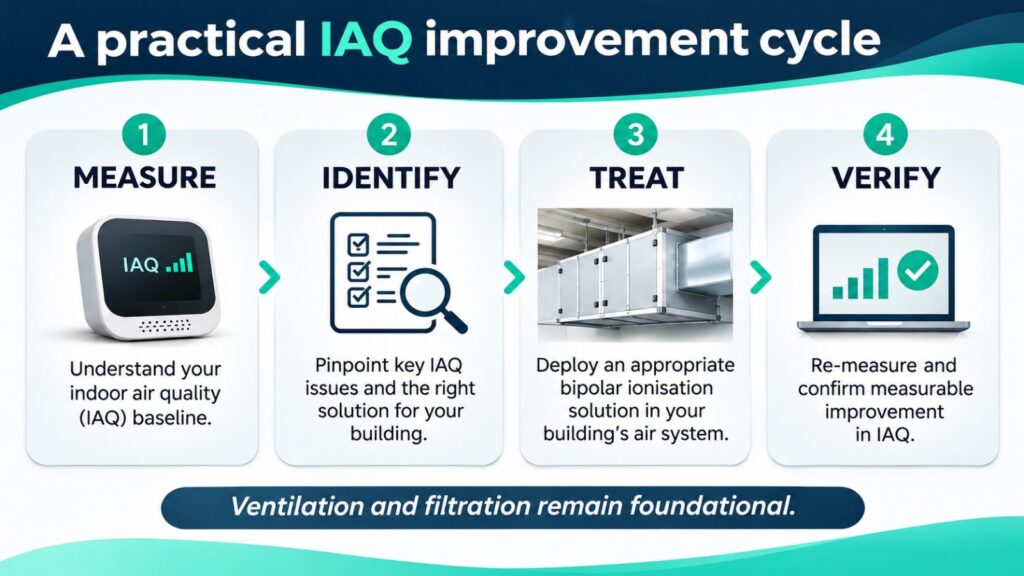
At PurAire Singapore, our approach is simple: measure, identify, treat and verify. Bipolar ionisation is one technology we may recommend within a broader indoor air quality (IAQ) plan.
What is bipolar ionisation?
Bipolar ionisation devices generate positively and negatively charged ions. Depending on the system design, operating conditions and pollutants present, these ions can interact with particles and certain substances in air. Commercial equipment can be integrated into air-handling units (AHUs), ducts and fan-coil units (FCUs), or supplied in room-level configurations.
The important distinction is between how the technology operates and what it demonstrably achieves in a particular building. Laboratory results, product specifications and actual occupied-building performance are not interchangeable. Performance depends on equipment design, airflow, placement, pollution sources, room geometry and maintenance.
Start with the problem, not the product
A stale office and a smoke-affected hotel room may both be described as having ‘bad air’, yet the underlying causes can be quite different.
In offices, elevated carbon dioxide can be a useful indicator of whether ventilation is adequate for the number of occupants. Fine particles (PM2.5) may arrive from outdoor traffic or indoor activities. Renovation materials and furnishings can release volatile organic compounds (VOCs). Ionisation does not itself supply fresh outdoor air or remove carbon dioxide; ventilation must address those needs.
In hotels, difficult odours may involve tobacco residue, damp materials, furnishings or housekeeping issues. Toilets offer have urine and ammonia odours. The correct response might combine source removal, cleaning, ventilation, dehumidification, filtration and bipolar ionisation air treatment. Fragrances do not remove the odour. A fragrance simply changes what people smell. Bipolar ionisation neutralizes the odour, eliminating it.
In HVAC systems, an in-duct device may be a practical way to add air treatment across multiple served spaces, but the suitability of any model depends on actual system capacity, airflow volumes, the location of the device and the size of the space being treated. PurAire offers over 30 different models of bipolar ionisers, as well as built-in airflow switches, so our ionisers only operate when there is actual airflow through the duct.
What should a facilities manager measure?
A useful IAQ assessment examines several parameters rather than relying on a single ‘air quality’ score.
- CO2: a ventilation and occupancy indicator, not a pollutant that ionisers directly remove.
- PM2.5 and PM10: fine particulate matter, for which appropriate filtration and source control remain
important. - VOCs: a broad category; different sensors and laboratory methods detect different compounds, so readings
require careful interpretation. - Temperature and relative humidity: relevant to occupant comfort, condensation and moisture
management.
PurAire supplies Atmocube and Kaiterra IAQ Monitors and sensors for 12-14 critical IAQ parameters and uses dedicated ozone measurement equipment, including the Aeroqual S500 with an appropriate sensor, for ozone checks, a calibrated VOC meter and a sophisticated Ionisation meter that measures both positive and negative ions.
Where does PurAire’s equipment fit?
PurAire supplies Glass Dielectric Barrier Discharge (DBD) bipolar-ionisation options for different spaces, including solutions intended for rooms, fan-coil units, ducts and larger air-handling systems. Selection should follow the actual application—not a one-size-fits-all model recommendation. This is why PurAire has over 30 different models.
The PurAire approach: MEASURE, IDENTIFY, TREAT, VERIFY
- MEASURE: Establish a baseline. Where necessary, take readings at different times and in different locations
so a short snapshot is not mistaken for typical conditions. - IDENTIFY: Determine the likely causes: insufficient outdoor air, particles, VOC sources, moisture, odourproducing materials, mould & mildew, body odours, tobacco, or a combination of these.
- TREAT: Correct the cause first. Where suitable, specify a supplementary air-treatment technology and an installation plan.
- VERIFY: Recheck the same relevant parameters under comparable conditions. Record what improved, what did not and whether further action is needed.
A before-and-after comparison is most useful when the instruments, measurement positions, occupancy and
operating conditions are documented. We believe this approach is more valuable than offering a promise of
‘fresh air’ without numbers.
Frequently Asked Questions
Can bipolar ionisation replace HEPA filtration?
No. HEPA and other specified filters physically capture particles passing through them. Ionisation operates differently and should not be treated as a replacement for appropriate filtration. This is why the PurAire Ultra-2 and Ultra-4 are not only bipolar ionisers but also air purifiers, because they incorporate HEPA 11 and HEPA 13 level filtration.
Can ionisation solve a high-CO2 office problem?
No. A high CO2 reading calls for a ventilation and occupancy assessment. Ionisation has no effect on carbon dioxide.
Can a system be fitted to an existing AHU?
YES, we do this frequently. Our choice of the appropriate model is based upon the airflow, size of the space being treated, odour source and type.
Better Indoor Air Starts with a Better Question
The most useful question is not ‘Which air purifier should we buy?’ It is ‘What is wrong with our air, how do we know, what is the appropriate solution to fix the problem, and how will we know it has improved?’
PurAire Singapore has served over 1,100 commercial customers since 2006. If your hotel, office, clinic or building has an ongoing indoor air quality concern, speak to us about a practical, measurement-first assessment and suitable options.
PurAire Singapore | www.puraire.sg | WhatsApp +65 9113 4015